IATF 16949:2016 without silos: how Pulsar GRC and Crewshift support Automotive quality
For Automotive organizations: Pulsar GRC structures IATF 16949:2016 requirements, customer-specific requirements, risks, CAPA, and evidence, while Crewshift closes competencies, training, and process exercises.
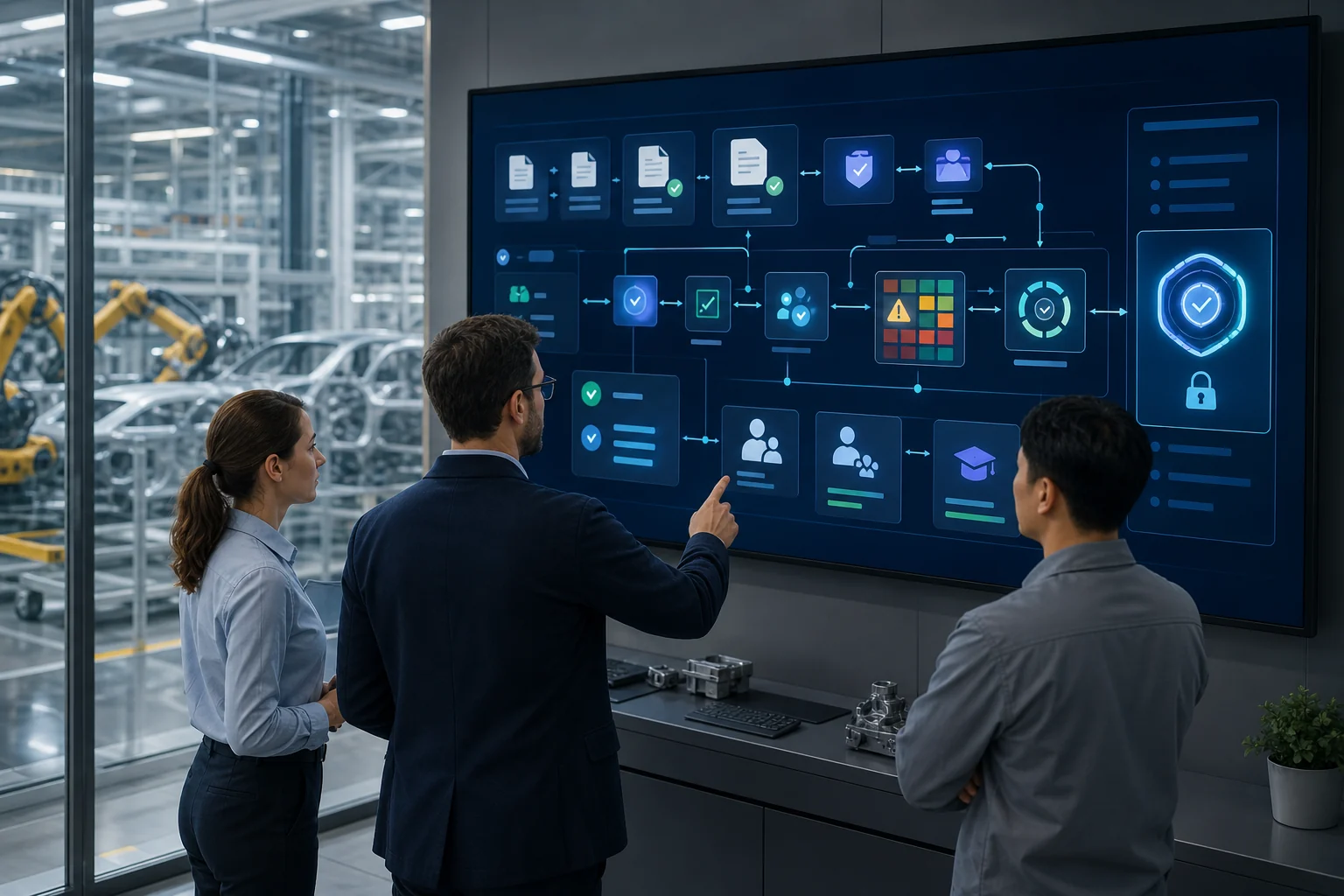
Automotive rarely lacks documents. The problem is using them as one operating system
Organizations in the Automotive supply chain rarely start from a blank page. They already have a quality management system, procedures, control plans, FMEA records, change registers, customer complaints, 8D actions, layered audits, supplier reviews, and customer-required documents. The difficulty appears when the team has to show how those pieces connect to IATF 16949:2016, ISO 9001:2015, and customer-specific requirements.
In practice, knowledge is scattered. Some of it lives in the QMS, some in spreadsheets, some in ERP or MES, some in project folders, and some in the heads of people responsible for quality, production, purchasing, process engineering, and logistics. During a customer audit, recertification, or preparation for a new product launch, the team has to reconstruct answers to simple questions:
- which requirement applies to which process,
- which control actually covers the requirement,
- where the current evidence is,
- who owns the action,
- whether the gap was closed properly,
- whether production, quality, and purchasing roles have confirmed competencies for their part of the process.
Pulsar GRC and Crewshift structure that flow without taking responsibility away from the Organization. Pulsar GRC covers requirements, controls, evidence, risks, and CAPA. Crewshift covers the people-side work: training programs, competency acknowledgements, role assignments, and scenario exercises. Both applications use the same Brillnet compliance logic and work on your Organization’s data in an isolated Data Area.
The important boundary: Pulsar GRC does not sell standard content
IATF 16949:2016 is an Automotive quality management system standard, implemented together with ISO 9001:2015 and extended by customer-specific requirements. The content of standards, interpretations, customer manuals, and OEM documents belongs to the relevant rights holders and must come from the Organization’s lawful sources.
That is why Pulsar GRC does not provide the text of IATF 16949:2016, does not sell ready-made requirement catalogues, and does not pretend to be an external consultant that “knows the standard for the customer”. The Quality/Compliance Manager imports the Organization’s own source documents into an isolated area for the Organization’s Sovereign Data. Only then does the platform help build the Coverage Graph, Gap Analysis, action register, and evidence packages.
AI plays the role of controlled process support aligned with the AI Act. It can help structure information, suggest connections, and accelerate analysis, but decisions about acceptance, priority, risk, and closure always remain with your Team and your Organization.
Day 1: a baseline from the Organization’s documents
The first step is not creating another spreadsheet. The Quality/Compliance Manager imports the Organization’s own documents into Pulsar GRC: the licensed IATF 16949:2016 copy, related customer-specific requirements, internal procedures, control plans, forms, work instructions, and production-process documents.
Pulsar GRC helps turn those materials into an operating baseline:
- Requirement structuring - AI support proposes a requirement structure, links to source documents, and operational context.
- Review by the Quality/Compliance Manager - a person accepts, rejects, or corrects the suggestions. This is subject-matter control, not an automatic import.
- Saving to the compliance catalogue - accepted requirements become work objects with a version, source, status, and owner.
After this step, the standard, procedures, and customer requirements are no longer separate documents sitting next to one another. They become a structured operating model that can be connected with processes, controls, evidence, and actions.
Coverage Graph: from requirement to evidence
In Automotive, saying “we have a procedure” is rarely enough. The Organization has to show that the requirement works in a specific process: supplier approval, engineering change, first-piece inspection, control of special characteristics, response to a customer complaint, or CAPA effectiveness review.
Pulsar GRC guides the mapping:
- requirement -> process,
- requirement -> control,
- control -> evidence,
- evidence -> owner,
- gap -> CAPA, risk, or justified decision,
- people-side action -> program or acknowledgement in Crewshift.
The result is the Coverage Graph. The Quality/Compliance Manager can see where the Organization has full coverage, where evidence is missing, where a control is too weakly described, and where readiness depends on the competency of a specific role. This changes the conversation with production, purchasing, and process engineering. Instead of asking “is everything ready?”, the team can show exactly where readiness is complete and where work is still needed.
Gap Analysis: fewer email statuses, more work on facts
Gap Analysis in Pulsar GRC is not a wish list. It is the result of AI-supported logic working on data entered by your Team: source documents, processes, evidence, controls, and decisions. Each gap can have an owner, priority, deadline, related risk, required evidence, and decision history.
Typical Automotive situations include:
- A critical component supplier change - Pulsar GRC shows which requirements and controls are affected, which evidence has to be updated, and who owns the decision.
- A customer complaint and 8D actions - the system connects the problem with a requirement, risk, CAPA, evidence that the action worked, and the Organization’s communication history.
- A new process version - the Coverage Graph shows whether the control plan, FMEA, workstation instructions, and role competencies have been synchronized.
- A layered audit - audit results can point to concrete gaps in evidence, controls, or training instead of ending as a general note.
The important change is that status is not a declaration. Status comes from connected objects: requirement, control, evidence, CAPA, owner, and completion acknowledgement.
Crewshift closes the people-side work
Many Automotive gaps are not caused by a missing procedure. They are caused by inconsistent execution. An operator knows the instruction but has no confirmed competency after a process change. A shift leader knows how to react to a nonconformity, but the exercise was not recorded. A quality engineer runs 8D, but lessons from the customer complaint do not reach the roles affected by the change.
This is where Crewshift fits. When a gap in Pulsar GRC requires people-side action, it can become:
- a training program for a specific role,
- a competency acknowledgement,
- a deadline reminder,
- a participant assignment,
- a scenario exercise,
- recorded conclusions and completion confirmation.
For Automotive, scenario exercises are especially valuable: response to a customer complaint, a shipping hold decision, analysis of a quality issue after a process change, customer-audit preparation, or walking through an 8D action path. Crewshift does not replace Pulsar GRC. It executes the part of the work that cannot be closed by an evidence register alone: competencies, behavior, decisions, and role readiness.
Suppliers, changes, and risk in one picture
The Automotive supply chain operates under constant change pressure. A new supplier, material change, customer specification update, batch issue, process correction, or delayed document can all affect quality requirements and evidence. In a traditional model, the team often sees the impact too late.
Pulsar GRC connects the supplier register, risks, evidence requirements, and CAPA with the same compliance catalogue. The question “does this supplier change affect our IATF readiness?” stops being detective work. The system shows dependencies, missing evidence, owners, and actions that need a decision.
This does not remove responsibility from the quality team. It gives the team a better view of the situation. The Quality/Compliance Manager can decide faster whether a gap requires CAPA, additional evidence, risk review, training in Crewshift, or a formal decision that the requirement does not apply in the given context.
Evidence package without the last-week search
The most expensive week before an audit is often the week of collecting evidence. The team knows the process works, but still has to find files, versions, decisions, acknowledgements, and owners. Pulsar GRC changes that model. Evidence accumulates during normal work, together with its context: requirement, control, CAPA, risk, owner, and decision.
For a customer audit, recertification, or management review, the team can prepare an evidence package with cryptographic verification. The auditor or customer sees a coherent set of materials, and the Organization’s team does not have to manually reconstruct history from many systems.
This shortens the audit conversation. Instead of explaining where something is, the team can show how the Organization manages the requirement: from the source document, through control and evidence, to corrective action, training, or decision.
Knowledge stays in the Organization
After an audit or launch project, the most valuable output is not the set of files. The real value is knowledge: which requirements were difficult, where gaps repeated, which evidence convinced the auditor, which CAPA actions actually worked, which roles needed additional training, and which decisions should be preserved for the future.
In the Brillnet-Pulsar-Crewshift model, that knowledge does not disappear after the report is sent. It remains in the Organization’s isolated Data Area and strengthens the next operating cycle. The next audit, customer request, process change, or production program starts from a better baseline.
That is the practical meaning of continual improvement. Not as a phrase in a procedure, but as a growing knowledge asset: requirements, evidence, decisions, risks, CAPA, competencies, and lessons from exercises.
Business value for Automotive
For an Automotive supplier, alignment with IATF 16949:2016 and customer requirements is not a separate quality-department project. It is a condition for operational predictability, customer trust, and control over the cost of errors.
Pulsar GRC and Crewshift support that predictability with a simple split:
- Pulsar GRC answers: are we covered by requirements, controls, evidence, risks, and CAPA?
- Crewshift answers: do people have the right competencies, acknowledgements, training, and rehearsed scenarios?
- The Brillnet compliance engine connects both areas with shared logic and AI designed for human oversight, decision traceability, and controlled use.
- The isolated Data Area lets the Organization build value on its own documents, evidence, and decisions.
The outcome is not “one more audit tool”. The outcome is less crisis-mode work, less manual status reconstruction, and a stronger ability to show the customer that the quality system works every day, not only during the week before a visit.
Want to see how this flow would work in your Automotive organization? Ask for Pulsar GRC access and describe your IATF 16949:2016 scenario.