Organizational data sovereignty: how an isolated Data Area strengthens GRC, AI, and continuous improvement
Review data access, document versions, decision history and human review of AI drafts in the organisation’s data area.
Last updated:
Hypothetical examples. The scenarios and outcomes explain a workflow; they are not a customer audit report or a guaranteed result. Check the current offer for feature scope, CrewShift workflows and service terms.
Data sovereignty is an organizational capability
In many companies, data sovereignty becomes a topic only when a customer, auditor, or legal team asks: where is the data, who can access it, and how quickly can you prove it?
Those questions matter, but they come too late if the Organization treats data sovereignty only as a security policy statement. In practice, it is an operational capability: the way a company stores documents, builds evidence, uses AI, and learns from each audit cycle.
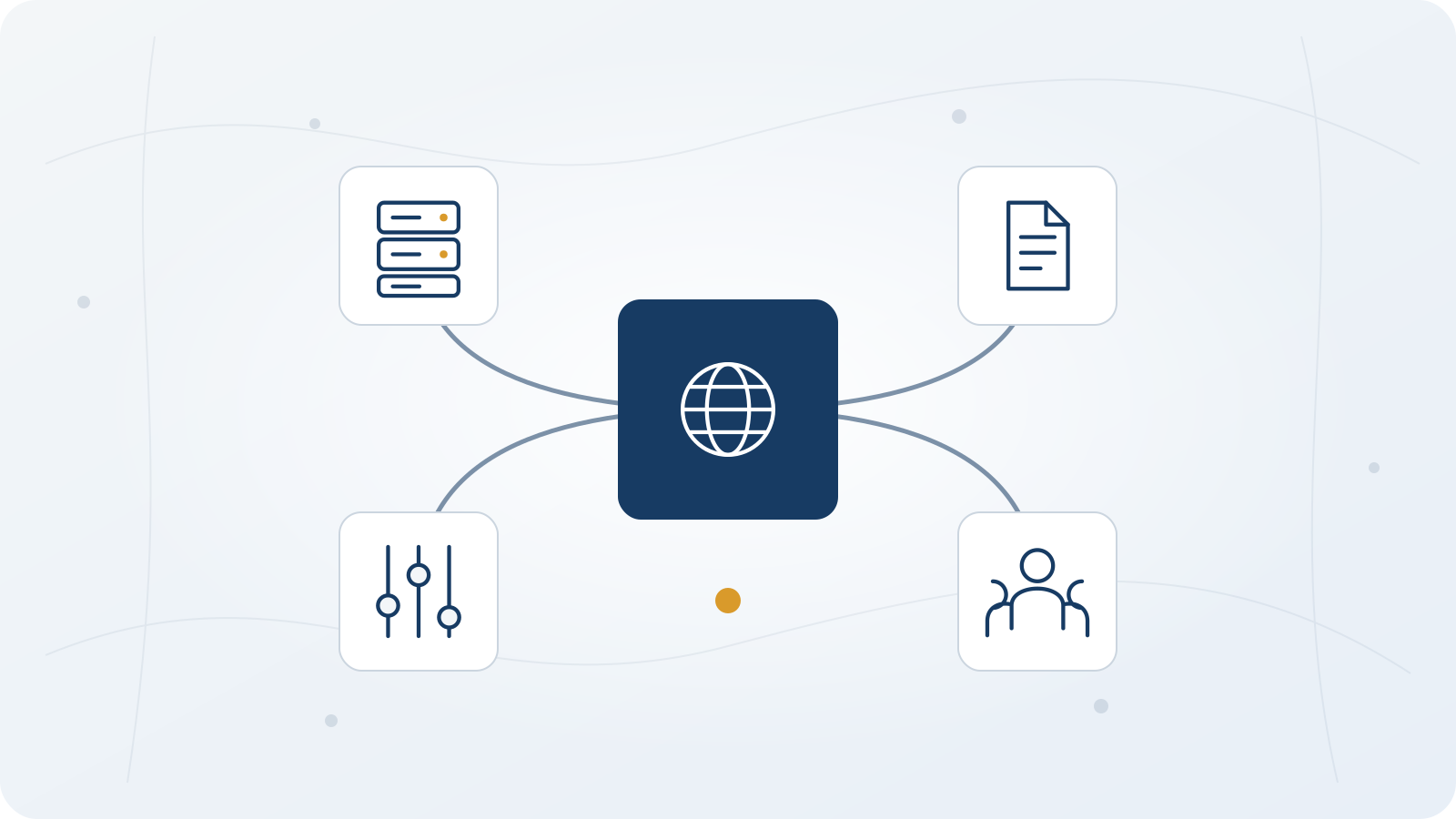
In the Brillnet architecture, this capability is designed around four elements:
- an isolated Data Area for your Organization,
- Pulsar GRC as the platform for documents, requirements, controls, risks, audits, CAPA, and evidence,
- Crewshift as a separate application for training, acknowledgements, competencies, and TTX workshops,
- the shared Brillnet compliance engine, which provides regulatory context and AI designed for human oversight, decision traceability, and controlled use in both products.
The result is not that the system “has AI”. The result is that the Organization starts building its own compliance and operational memory.
The isolated Data Area is the starting point
In a typical SaaS setup, customer data is placed in a shared application layer, while isolation is described mainly through roles, permissions, and a tenant identifier. That is still necessary, but often not enough in regulated environments.
In the Brillnet architecture, each organization has a separate database, file store, audit and encryption context. The shared layer holds only routing, licensing, billing and technical operations data. It does not store organization documents, evidence or AI content. Service scope and support access are documented in the service agreement.
This separation creates value that is easy to explain outside IT:
- it is easier to explain where the Organization’s data is located,
- the boundary between customers is easier to prove,
- backup, retention, and export planning become clearer,
- AI can be used more safely on the Organization’s documents,
- conversations with enterprise customers, auditors, and procurement teams become more precise.
This is not an infrastructure detail. It is the trust foundation for the whole GRC process.
Knowledge that accumulates instead of disappearing after an audit
In many Organizations, every audit starts almost from scratch. The team looks for current procedures, reconstructs decisions from email, collects evidence from folders, and tries to remember why a previous action was accepted as sufficient.
Pulsar GRC changes that model by structuring the flow:
Documents -> Requirements -> Controls -> Risks -> Audits -> CAPA -> Evidence
When documents and evidence are added, retain their version, owner and relationship to the decision they support. A later reviewer should be able to distinguish the approved instruction from an obsolete copy and identify the facts available at the time. If an AI draft is prepared, verify its source references and its scope before approval. This proposed method uses the organisation’s documented history; it does not assume an automatically growing knowledge layer.
This is a practical form of continuous improvement. Not a slogan in a presentation, but a working loop:
- The Organization imports its own documents and requirements.
- Pulsar GRC helps build the Coverage Graph and Gap Analysis.
- The team makes decisions, assigns actions, and closes evidence.
- Crewshift can take over training, acknowledgements, competencies, or TTX workshops.
- Results come back as knowledge and evidence that make the next review easier.
The Organization does not lose knowledge when the audit closes. Every next cycle starts from a better position.
One compliance engine, two applications
Pulsar GRC and Crewshift use the same Brillnet compliance engine, but they solve different problems.
Pulsar GRC structures the compliance area: documents, requirements, controls, risks, audits, CAPA actions, evidence, the Coverage Graph, and Gap Analysis.
Crewshift structures the people and change adoption area: training, acknowledgements, knowledge checks, competencies, rollout campaigns, and TTX workshops. If Gap Analysis shows that a team needs training or a scenario needs to be exercised, Crewshift is the right application for that part of the work.
The shared compliance engine means the two products do not create two separate stories. The Organization can see the relationship between a requirement, an action, evidence, and the team’s capability.
Regulatory context without taking decisions away from the Organization
Optional reference material from official public sources has provenance, a version and a verification date. Copying it into the organization area creates a draft requiring assessment and approval. Organization knowledge and its search index remain within its data area. An authorized user invokes AI explicitly; it does not analyze changes in the background or activate requirements on its own.
The boundary is deliberate: Brillnet does not sell standards content or ready-made requirement catalogues. Standards, procedures, and requirements relevant to your sovereign Data Area are supplied by your Organization. Pulsar GRC maps them inside the isolated Data Area and helps produce the Coverage Graph and Gap Analysis. Decisions on acceptance, priority, and closure always stay with your Team and your Organization.
This matters because AI should support the process, not replace the Organization’s responsibility.
What the Organization gains
1. A shorter path from question to evidence
When a customer asks about a requirement, control, or corrective action status, the team does not start by searching inboxes and folders. It has a flow in which the document, decision, owner, action, and evidence are connected.
2. More value from every iteration
A reusable history requires active maintenance. When a procedure changes, identify affected decisions and ask their owners whether another review is needed. Preserve earlier versions so that past choices remain intelligible, while showing clearly which version is current. The value depends on the quality of these records and the review performed by people. Merely retaining more files does not demonstrate that an earlier conclusion is still valid.
3. Safer AI adoption
AI support works on data in a controlled context. AI helps analyze, structure, and suggest next steps, but final operational, quality, and compliance decisions stay with your Team.
4. Fewer silos between compliance and people
Pulsar GRC shows what must be met and proven. Crewshift helps bring the change to people through training, acknowledgements, competencies, and exercises. This closes the gap between a document and real operational behavior.
5. A stronger enterprise customer conversation
Data sovereignty, an isolated Data Area, and a consistent evidence trail make it easier to answer questions about security, access, retention, AI, and audit readiness. The sales or implementation team does not have to improvise answers.
When this becomes urgent
Most often, this happens when:
- an enterprise customer asks about data isolation and access paths,
- the Organization wants to use AI in regulated processes,
- an audit requires a quick link between requirement, control, and evidence,
- a legal change requires an impact assessment across procedures, training, and ownership,
- compliance knowledge is spread across people, folders, and spreadsheets.
If a simple question takes several days of material collection, the issue is not only compliance. It is the Organization’s operational memory.
Summary
Data sovereignty becomes operational when access, records and decisions are managed together. Use the organisation’s data area to organise documents and their history, then verify the applicable service scope and access arrangements. Where work involves Pulsar GRC and CrewShift, agree how responsibilities and evidence pass between the available workflows. Assess the result on actual cases rather than assuming automatic improvement from the architecture.
This approach helps move from “we collect evidence before the audit” to “we build evidence and knowledge as work happens”. This is where real continuous improvement appears: every decision, gap, action, and evidence item can increase the value of the next compliance cycle.
Next step
- See the documents -> requirements -> controls -> risks -> CAPA -> evidence flow: Demo
- Review Pulsar GRC modules and Crewshift’s role in training and TTX: Modules
- Discuss data, hosting, version history, and AI requirements for your Organization: Contact
Verify sovereignty with an evidence request
The checks below are a proposed procurement and operating method. Isolation claims should be tested against the service documentation, contract and practical access paths. Request a clear account of where organisational content, backups, search indexes and AI processing are located; which subprocessors can receive content; and what support access is possible. Hosting a primary database in the EU does not by itself answer those questions.
Separate architecture statements from contractual commitments and test results. A diagram explains the intended design. A service agreement states the committed service scope. An access review or recovery test shows operation within its defined conditions. No single document proves every dimension of sovereignty. Record unanswered questions as gaps with an owner rather than converting an attractive diagram into a blanket security assurance.
For personal data, determine the roles for each processing activity and the applicable legal basis. The EDPB materials listed below explain controller and processor responsibilities. The organisation’s evidence store may include employee training records, supplier contacts or incident details. A compliance purpose does not remove the need to limit access, define retention and consider the people whose information is present.
Test export before relying on accumulated knowledge
Take a hypothetical supplier case with a source document, reviewed requirement, linked control, evidence and decision. Request the available export using the current service arrangements. Check whether a colleague can reconstruct the case outside the application: which file was used, which version applied, who approved the decision and which action remained open. A collection of files without those relationships may be insufficient for an exit or audit plan.
Record formats, identifiers and any limitations. Test a small representative case before the organisation has accumulated years of material. If some relationships require manual documentation, include that work in the exit plan and its cost. Do not promise that export is instant or universally interoperable without verifying the actual method available under the current offer.
Recovery and export answer different questions. Recovery asks whether the service can restore usable information after a failure. Export asks whether the organisation can obtain and interpret information for another legitimate purpose. A successful recovery does not prove portability, and a readable export does not prove recovery within the required time. Assess each against its own acceptance criteria.
Keep AI output traceable to approved material
An AI-supported answer should identify the material it relied on and remain subject to review. In a hypothetical review, a superseded procedure remains in the history because it was used for a past decision. A current question must not silently treat that procedure as the active instruction. Check whether the relevant source version is explicit, and compare the answer with the approved baseline before using it operationally.
Include a deliberate conflict test: two source versions with different review frequencies, one current and one superseded. Ask the reviewer to verify that the answer recognises the difference or marks uncertainty. This is an evaluation technique, not a claimed automatic feature. Record the outcome and any restrictions on using AI in the affected process.
Uploaded documents can also contain irrelevant or hostile instructions. Treat their contents as evidence and reference material, not authority to change access, reveal confidential information or approve a decision. A person should verify extraction results against the source and reject instructions that are unrelated to the organisation’s task.
Maintain the boundary after implementation
Review access when roles change, a support case requires access or a new AI or subprocessor arrangement is introduced. Confirm what changed, who authorised it and whether retention or transfer assumptions need updating. An organisation’s data map is useful only while it reflects the actual service and actual use.
Sovereignty therefore includes a practical ability to obtain answers, restrict use, retain the right history and leave with understandable evidence. Pulsar GRC’s organisational data design can support that work, but the organisation should evaluate the current service scope and its own operating controls rather than infer compliance from the design alone.
Sources and scope
- GDPR — Regulation (EU) 2016/679
- EDPB — Secure personal data
- EDPB — Controller or processor
- Pulsar GRC — access, data isolation and export policy (Polish)
Informational material. It does not replace licensed standards or individual legal advice.